On this page
The short answer
Measure the inseam without shoes. Lower the saddle until both feet reach the floor while the child sits. Set the saddle at or below that inseam, then check that the hands reach the bars with a small bend in the elbow. A balance bike that passes those three checks fits, whatever number sits on the tire.
- Inseam decides the saddle height. Height only narrows the search.
- The chart's two balance bikes start at 22 cm and 30 cm of inseam.
- Wheel size tells you how the bike rolls, not how low the seat goes.
Check the size
Kids bike size chart by height and wheel sizeRead the same figures in one table, then check the size you picked in the bike size calculator.
01
What decides a balance bike fit
A balance bike has no pedals, so the child walks, runs, and glides with the feet. That makes the saddle height the whole fit. The child must reach the floor with both heels while seated. A saddle one hand too high leaves the child on tiptoe, and a child on tiptoe cannot push off or stop with confidence.
The chart lists a rider inseam range for each balance bike. Read the lower number as the smallest rider the bike covers, and the upper number as the tallest. Your child's inseam has to land inside that range, ideally near the lower half, because the seatpost needs room to move up as the child grows.
Three checks on the bike itself
- Both heels touch the floor while the child sits on the saddle.
- The knees keep a slight bend, so the legs can push.
- The hands reach both grips without locking the elbows.
Sit the child on the saddle and watch the heels.
02
Measure the inseam at home
Inseam is the distance from the floor to the crotch, measured along the inside of the leg. It is not the trouser length on the label, and it is not the child's height. Measure it once, write it in centimeters, and keep the number for every bike you compare.
Work on a hard floor. Carpet lets the book sink, and a sinking book shortens the measurement by a centimeter or more. Measure twice, and take the larger number when the two readings differ.
- Stand the child against a wall without shoes, feet about a hand apart.
- Raise a hardback book between the legs until it touches the crotch.
- Hold the book level and mark the wall at its top edge.
- Measure from the floor to the mark in centimeters.
- Repeat the measurement and keep the larger of the two.
Write the inseam in centimeters before you open a listing.
03
Compare the inseam with the two balance bikes
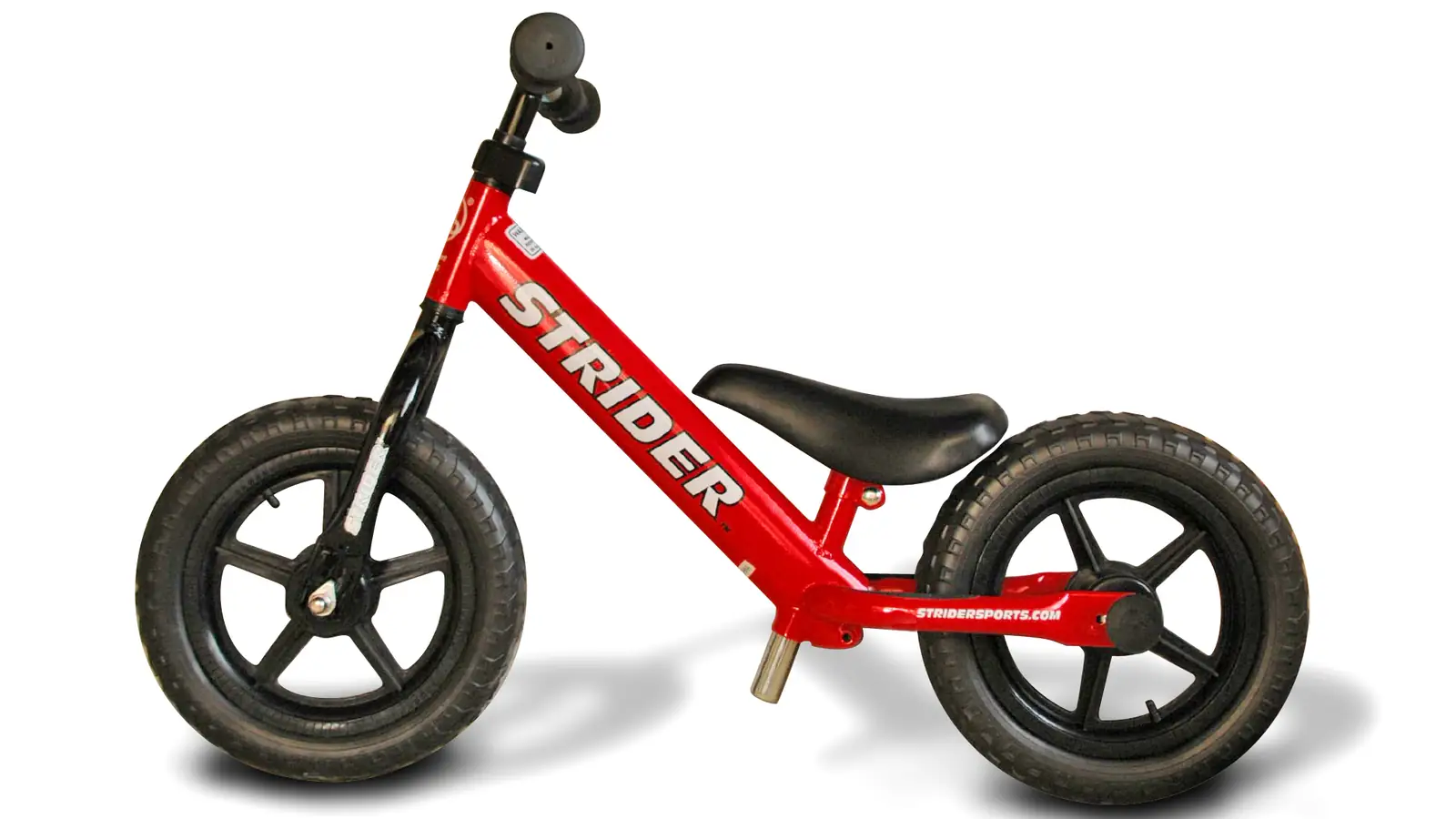
The chart lists 2 balance bikes. The Strider Baby Balance Bike covers 48–65 cm of rider height and 22–30 cm of inseam. The 10" Balance covers 80–100 cm of height and 30–40 cm of inseam.
A child with a 22 cm inseam sits at the bottom of the smaller range and below the larger one. At 30 cm the two ranges meet: that inseam is the top of the smaller range and the bottom of the larger one, so either bike can work.
The lower end of each range matters more than the upper end. A saddle that drops to the child's inseam can always rise later. A saddle that stops above it never fits.
Strider Baby Balance Bike
- Brand
- Strider
- Rider height
- 48–65 cm †
- Rider inseam
- 22–30 cm
10" Balance
- Brand
- Joystar
- Rider height
- 80–100 cm
- Rider inseam
- 30–40 cm
Choose the bike whose lowest inseam is at or below your child's.
04
Why the wheel size misleads
The chart lists 10 kids bikes with a twelve-inch wheel. Their lowest published inseam runs from 28 cm to 35 cm. That is 7 cm of difference on one wheel diameter.
Wheel size and saddle height come apart in both directions. The 10" Balance starts at a 30 cm inseam, and the lowest twelve-inch bike starts at 28 cm. The smaller wheel does not sit lower. The frame, the seatpost, and the saddle shape decide where the seat ends up.
Use the wheel to judge the ride. A twelve-inch wheel rolls over pavement joints that stop a ten-inch wheel, and it lasts longer on gravel and grass. Then use the published inseam to judge the fit.
12" (Trike / Elm)
- Brand
- Schwinn
- Rider height
- 74–97 cm
- Rider inseam
- 28–40 cm
12"
- Brand
- Specialized
- Rider height
- 82–100 cm
- Rider inseam
- 30–40 cm
12"
- Brand
- Marin
- Rider height
- 82–100 cm
- Rider inseam
- 30–40 cm
12"
- Brand
- Joystar
- Rider height
- 84–104 cm
- Rider inseam
- 35–44 cm
12" Wheel (ages 1-4)
- Brand
- Cubsala
- Rider height
- 86–105 cm
- Rider inseam
- 35–47 cm
12"
- Brand
- RoyalBaby
- Rider height
- 85–105 cm
- Rider inseam
- 35–44 cm
Compare the saddle height, not the wheel sticker.
05
Set the saddle and check the bars
Loosen the seatpost clamp and slide the post down until the child's heels touch the floor. Tighten the clamp to the torque printed on it. A post that slips while the child rides is more dangerous than a saddle set a centimeter low.
Keep the seatpost inside the frame above its minimum insertion mark. The mark is a line or a set of dots on the lower part of the post. A post raised above the mark can snap the frame at the seat cluster, and a post left long inside the frame is harmless.
The bars matter as much as the saddle. The child should reach both grips with a small bend in the elbow and the shoulders relaxed. Bars that sit far forward pull the child off the saddle, and bars that sit too high lift the hands away from the brake lever.
- Heels flat on the floor, knees slightly bent.
- Seatpost above the minimum insertion mark.
- Elbows slightly bent, hands on both grips.
Keep the seatpost above its minimum insertion mark.
06
Frame shape, weight and brakes
A balance bike frame has a low step-through shape, so the child can stand over it with both feet flat on the floor. That open frame is the reason a balance bike looks different from a pedal bike. Stand the child over the frame before you buy and check that the top tube clears the crotch.
Weight decides how the bike feels to a small rider. A child who can lift and carry the bike can also pick it up after a fall and steer it at walking pace. Lift the bike yourself before you buy. If it feels heavy in your hand, it is heavy for the child.
Most balance bikes have no brake. Add one when the child rides faster than walking pace, and only if the hand reaches the lever with the first joint of the index finger. A lever the child cannot reach teaches the wrong habit, because the child learns to drag the feet instead.
Lift the bike yourself. A heavy bike is heavy for the child.
07
When to move to a pedal bike
Move up when the child glides with both feet off the ground, steers around a marker, and stops without dragging a foot. Age is a poor signal. A confident three-year-old can be ready, and a cautious six-year-old may still be learning to glide.
The next sizes in the chart are the fourteen-inch and sixteen-inch kids bikes. The fourteen-inch size covers 95–110 cm of height and 38–46 cm of inseam, and the chart lists 3–5 years as the typical age. The sixteen-inch size covers 100–115 cm of height and 42–52 cm of inseam, with 4–6 years as the typical age.
Check the inseam at the pedal bike too. A child at the top of the balance bike's range may still be at the bottom of the fourteen-inch size, and a bike that arrives too tall sends the child back to the balance bike.
14" wheel
- Rider height
- 95–110 cm
- Rider inseam
- 38–46 cm
- Typical age
- 3–5 years
16" wheel
- Rider height
- 100–115 cm
- Rider inseam
- 42–52 cm
- Typical age
- 4–6 years
Move up when the child glides with both feet up.
08
The six-point check before you pay
A balance bike is a small purchase with a short life, so the checks take a minute. Run them on the bike in the shop or against the listing's size table. If the seller publishes no inseam, ask for the lowest saddle height instead, measured from the floor to the top of the saddle at its lowest setting.
Write the inseam down first, then the seat range. Two numbers make the decision, and neither of them is the wheel size on the product title.
- Child's inseam, measured barefoot, in centimeters.
- Lowest saddle height at or below that inseam.
- Seatpost above the minimum insertion mark.
- Hands reach both grips with a slight elbow bend.
- Both feet stand flat over the frame.
- Brake lever, if fitted, within reach of the first finger joint.
Run the six checks before you pay.
Questions
Balance bike sizing FAQ
How do I know what size balance bike to buy?
Measure your child's inseam, then compare it with the lowest saddle height on the bike. The saddle must drop to the inseam or below so both feet reach the floor. Wheel size and age only narrow the list. The chart lists rider inseam for each balance bike, and the two balance bikes start at 22 cm and 30 cm.
Should a child's feet be flat on the ground on a balance bike?
Yes. A child on a balance bike walks and glides with the feet, so both heels must reach the floor while seated. A child on tiptoe cannot push off or stop without falling. Set the saddle low at first, then raise it as the child learns to glide.
What wheel size is a balance bike?
Most balance bikes use a 10-inch or 12-inch wheel. The wheel changes how the bike rolls over curbs and gravel, not how low the saddle goes. A 12-inch bike can publish a lower seat than a 10-inch bike, so compare the inseam range rather than the wheel.
Is a 12 inch bike too big for a 2 year old?
Wheel size does not decide that. A 12-inch bike with a low saddle can fit a two-year-old, and a 10-inch bike with a high saddle may not. Measure the inseam and compare it with the published seat range. The twelve-inch bikes in the chart start at inseams from 28 cm to 35 cm.
How do I measure a toddler's inseam?
Stand the child against a wall without shoes, feet a hand apart. Raise a hardback book between the legs until it touches the crotch, mark the wall at the book's top edge, and measure from the floor. Repeat once and keep the larger number. Measure on a hard floor, because carpet shortens the result.
When should a child move from a balance bike to a pedal bike?
Move up when the child glides with both feet off the ground, steers around a marker, and stops without dragging a foot. The chart's next sizes are the 14-inch and 16-inch bikes, with inseam ranges of 38–46 cm and 42–52 cm. Check the inseam before the birthday.
Do balance bikes need brakes?
Most balance bikes have no brake, and a child who walks the bike does not need one. Add a handbrake when the child rides faster than walking pace, and only if the hand reaches the lever with the first finger joint. A lever out of reach teaches the child to drag the feet.
Can I lower the saddle on any balance bike?
Only to the minimum insertion mark on the seatpost. Below that line the post can damage the frame. If the saddle cannot reach your child's inseam at the mark, the bike is too tall, and a smaller frame is the answer rather than a lower saddle.
Next steps
Check the size before you buy
Kids bike size chart
Wheel sizes from 12 to 26 inches, by rider height and inseam.
Bike size calculator
Add the child's height and inseam and get a starting wheel size.
Kids bike sizing guide for ages 9 to 12
What the 20, 24, and 26 inch rows cover once the balance bike is outgrown.
Bike wheel size chart
Why a 12 inch wheel covers such a wide range of riders.
Sources
Where these numbers come from
Every figure comes from a published size chart, geometry table, or growth chart. Open a source to check a number against the page it was read from.